
Guide · Glutes
Cable glute exercises: 11 moves that work on one or two towers
Which cable exercises train your glutes, how to set each one up, and how to put them into one session. With animations from the app and what research does and doesn’t say.
11 exercises6 work on one tower
In short
- Core moves: a hinge (Cable Pull-Through or Romanian Deadlift), a Belt Hip Thrust and a single-leg squat such as the Bulgarian Split Squat.
- Add-ons: Cable Glute Kickback and Cable Hip Abduction with an ankle cuff. The abduction trains the side of your hip, which squats and hip thrusts barely grew in a recent study.
- Dose: 3 sets of 8 to 12 reps on the big moves, 10 to 15 on the small ones, once or twice a week. Add weight when you hit the top of the range in every set.
- One tower? Six of the eleven exercises need only one cable.
Your glutes: two jobs, three muscles
The gluteus maximus is the big muscle that shapes your backside. Its main jobs are hip extension, which means driving your thigh back or your hips forward, and turning the thigh outward. Its upper part also helps lift the leg to the side[1].
The gluteus medius and the smaller gluteus minimus sit higher, on the side of the hip. The medius moves your leg out to the side (abduction) and helps keep the hip joint stable under load[1].
So a complete glute session needs two kinds of exercise: hip extension under load, and abduction.
Hip extension
Mainly gluteus maximus
Hip extension
Hinges: heavy hip work on a cable
In a hinge your hips go back and forward while your knees stay almost straight. Glutes and hamstrings share the work. The cable runs from the lowest pulley, so these load your hips without a barbell on your back.
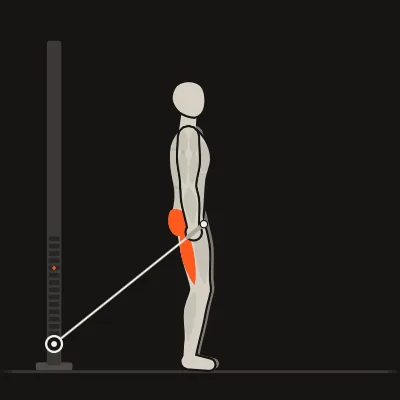
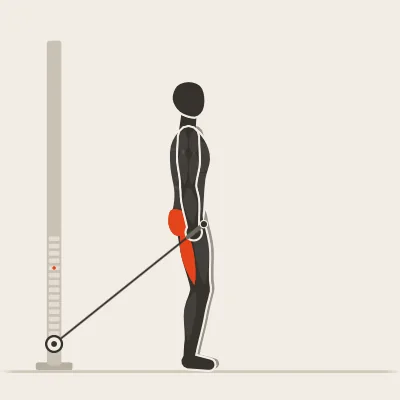
Cable Pull-Through
The pull comes from behind and teaches you hip extension, and it is very easy on your back. A good first hinge to learn.
- Back to the machine, grab the rope between your legs
- Take two steps forward, hips far back
- Drive your hips forward, squeeze your glutes at the top
- Arms stay straight, they only hold the rope
Romanian Deadlift
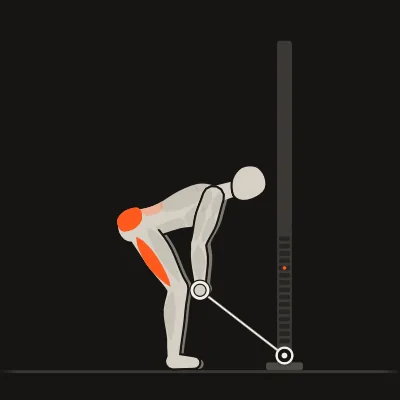
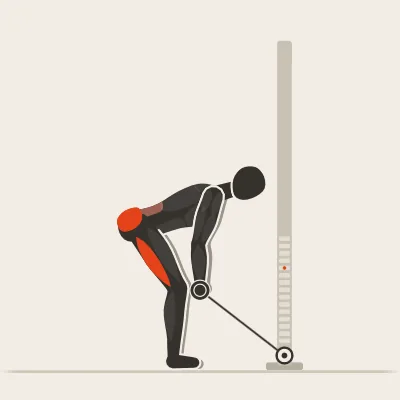
Both stacks at once, so your glutes and hamstrings can work with a lot of weight. Needs two towers.
- Stand close to the pulleys, knees very slightly bent
- Push your hips back as if closing a door with your bum, back straight
- Keep the handles close to your legs, down to just below the knee
- Squeeze your glutes and drive your hips forward
One-Cable Romanian Deadlift
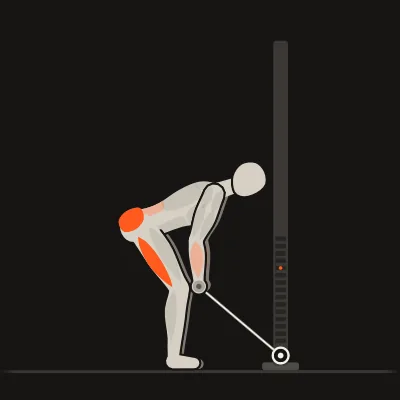
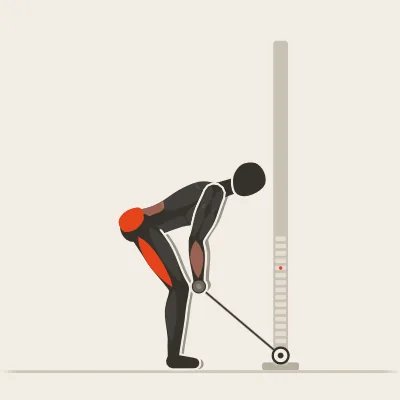
The one-tower version of the Romanian deadlift: a short bar or EZ bar clipped to the middle of one cable.
- Stand close to the pulley, the cable runs between your shins
- Push your hips back, knees slightly bent, back straight
- Slide the bar down close to your thighs to just below the knee
- Squeeze your glutes and drive your hips forward
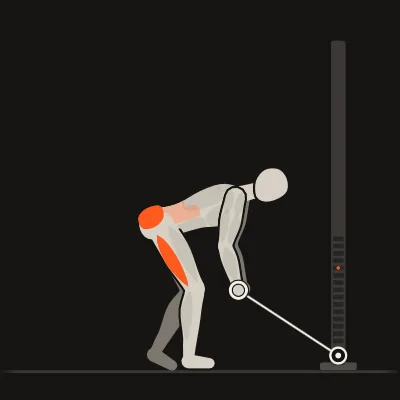
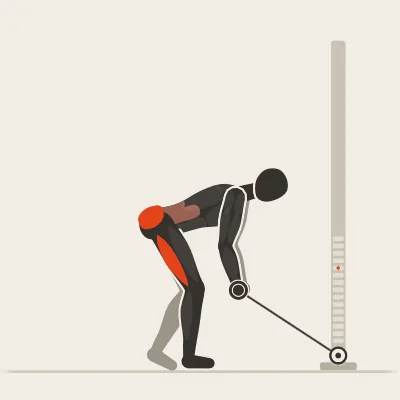
Kickstand Romanian Deadlift
Almost all the weight goes on the front leg, so one cable is enough for a hard set. The back foot only helps you balance.
- Front foot flat, back foot on its toes next to your front heel
- Push your hips back, keep the handle close to your front leg
- Hips stay square, don’t let them turn toward the cable
- Come up using your glutes and hamstrings, then switch sides
Hip extension
Belt hip thrust: glutes in the top position
The hip thrust trains hip extension lying with your upper back on a bench. On a dual cable machine the load comes from a dip belt on both cables, so there is no bar on your hips.
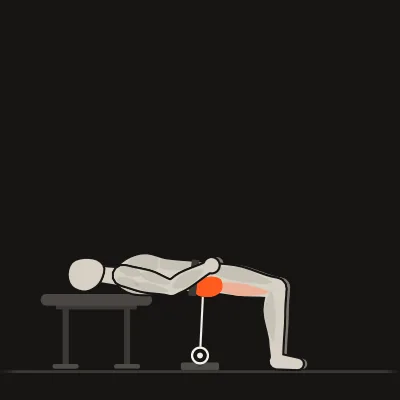
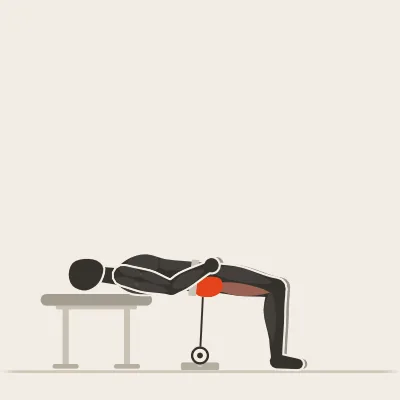
Belt Hip Thrust
Set the bench crosswise between the towers so the cables run straight down beneath your hips. At the top your shins should be vertical: then your glutes do the work, not your hamstrings.
- Shoulder blades against the edge of the flat bench, feet hip-width apart
- Chin to chest, keep your ribs down
- Drive your hips up until torso and thighs form a straight line
- Squeeze for two seconds at the top, lower slowly
Hip and knee extension
Single-leg squats and lunges
Almost all the weight is on one leg, so the cable machine’s weight is enough even for strong legs. These train your quads as much as your glutes.
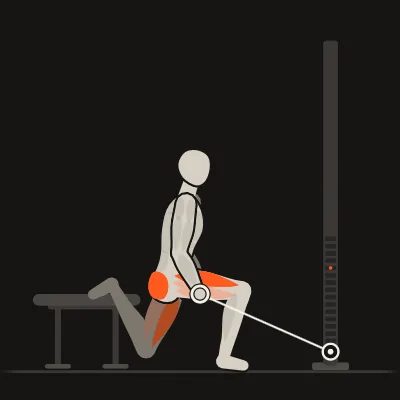
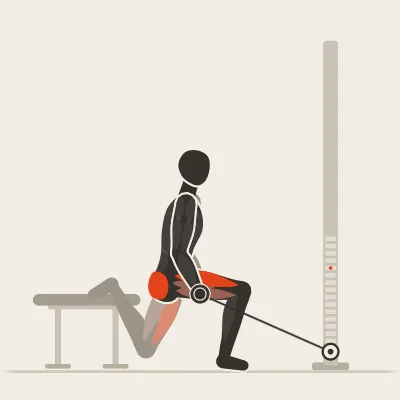
Bulgarian Split Squat
Back foot on a box, almost all the weight on the front leg. Go as deep as you can control. If you wobble, take one handle in the hand opposite your front leg and hold the frame with the other.
- Rest the top of your back foot on a bench or box
- Front foot far enough forward, shin almost vertical
- Lower straight down until your back knee almost touches the floor
- Drive up through the front heel, then switch sides
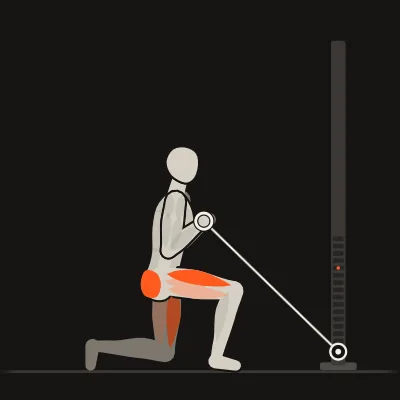
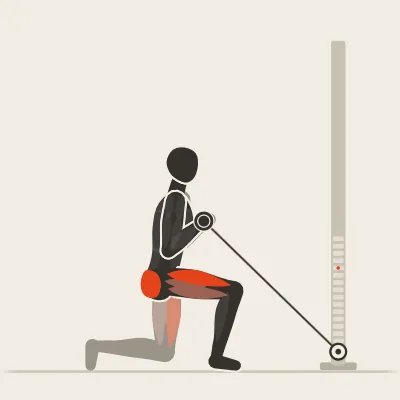
Cable Reverse Lunge
Stepping back is easier on the knees than stepping forward, and the cable from the front pulls you into a good position.
- Stand tall in front of the machine, handles at your chest
- Take a big step back
- Back knee toward the floor, front shin vertical
- Drive through the front heel back to standing
Cable Step-Up
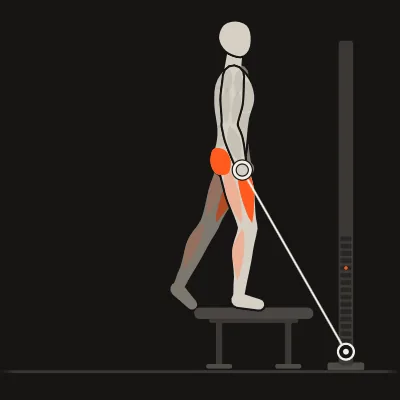
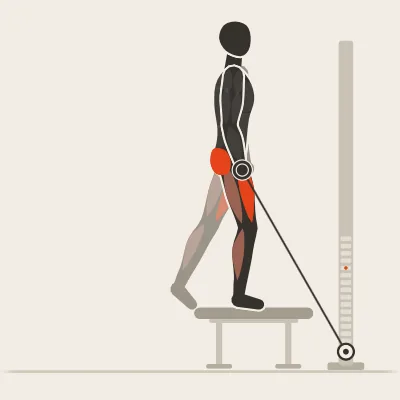
The top leg does all the work. Extend your hips fully at the top and take three seconds on the way down.
- Place your whole foot on a bench or box
- Drive up through the top leg, don’t push off the floor
- Extend your hips fully at the top
- Step down slowly and under control, then switch sides
Cable Goblet Split Squat
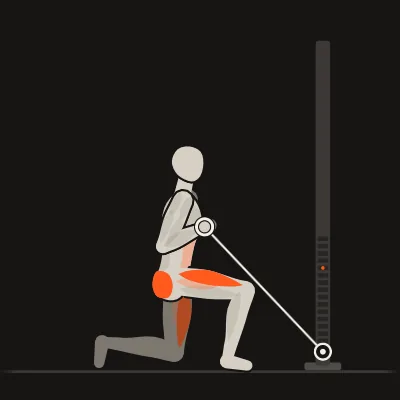
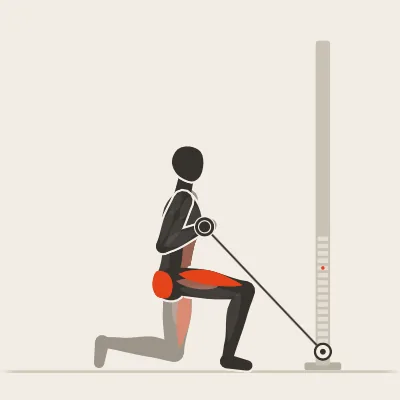
The one-tower option: both hands on one handle in front of your chest. The cable pulling from the front helps your balance.
- Face the machine, long split stance
- Lower straight down, back knee toward the floor
- Front knee stays over your foot, upper body upright
- Drive up through your whole front foot, then switch sides
Isolation
Kickback and abduction: the ankle cuff moves
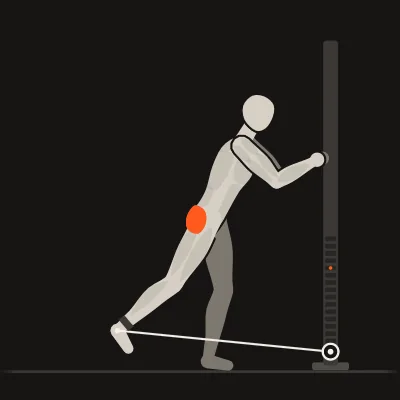
Two small exercises with an ankle cuff on the lowest pulley. They need little weight and fit at the end of a session. The abduction covers the side of your hip.
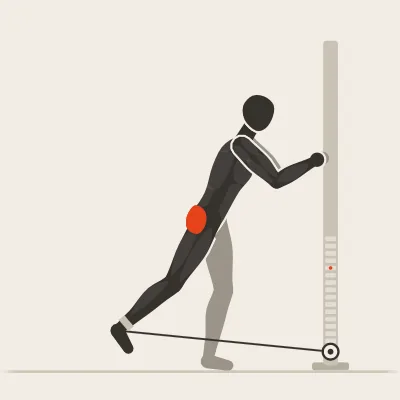
Cable Glute Kickback
Small movement, big effect: your back stays still, only the leg moves. If your lower back arches at the top, the leg has gone too far.
- Hold on to the tower, torso leaning slightly forward
- Drive your straight leg back and up
- Squeeze your glute at the top, don’t arch your lower back
- Return slowly, then switch sides
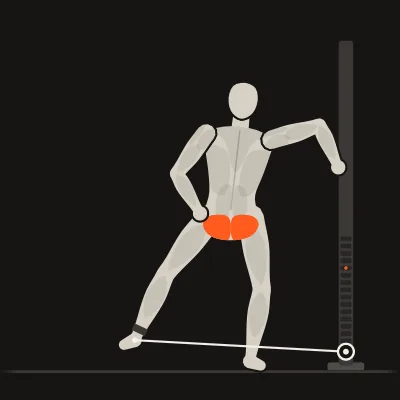
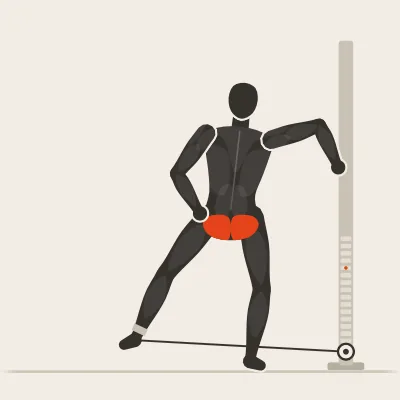
Cable Hip Abduction
Trains the gluteus medius. Toes point forward, not up: otherwise the hip flexor takes over.
- Side-on to the machine, inside hand on the tower
- Raise your straight outside leg out to the side
- Pelvis stays level, torso upright
- Return slowly, then switch sides
What research says, and what it doesn’t
Most glute studies measure muscle activity with EMG. That is useful, but it is not the same as growth.
EMG is not growth
EMG shows how strongly a muscle is activated during a movement. It does not tell you how much the muscle will grow over weeks of training[4]. In a nine-week study with MRI scans, hip thrusts produced more glute EMG than squats, yet both grew the glutes by a similar amount[3].
High glute activity in many moves
A review of EMG studies found very high gluteus maximus activity in step-ups, split squats, lunges, hip thrusts, deadlifts and belt squats[2]. For the side of the hip, standing abduction with resistance at the ankle was among the highest for the gluteus medius[1]. Those studies used bands, not cables, and again: activity, not growth.
The side of the hip needs its own exercise
In the same nine-week study, neither squats nor hip thrusts did much for the gluteus medius and minimus[3]. That is one reason to add abduction. Whether cable abduction grows them has not been tested directly.
Use the full range
Full squats grew the gluteus maximus more than half squats in a ten-week study[5]. That study used barbell squats, but it supports going deep in split squats and lunges as far as you can control.
Heavy or light both work
Heavy and light loads grew muscle by a similar amount when sets were taken to failure[6], so higher reps are fine for kickbacks and abduction. Going all the way to failure showed no clear advantage over stopping a little short[8], and more weekly sets tend to bring more growth[7].
What is missing
There are no long-term studies on cable kickbacks or cable pull-throughs themselves. Their place in this guide comes from what they train (hip extension, abduction) and how well they fit a cable machine, not from direct proof that they beat other exercises.
Sample glute workout on a cable machine
One hinge, one thrust or single-leg move, then the small exercises. These are the rep ranges DCFT uses for the goal “build muscle”: 8 to 12 reps on exercises with several joints, 10 to 15 on isolation exercises.
Two towers
| Exercise | Sets × reps | Rest |
|---|---|---|
| Romanian Deadlift | 3 × 8 to 12 | 2 min |
| Bulgarian Split Squat | 3 × 8 to 12 per leg | 2 min |
| Belt Hip Thrust | 3 × 10 to 15 | 75 s |
| Cable Hip Abduction | 3 × 10 to 15 per leg | 75 s |
| Cable Glute Kickback | 2 × 10 to 15 per leg | 75 s |
One tower
| Exercise | Sets × reps | Rest |
|---|---|---|
| Cable Pull-Through | 3 × 8 to 12 | 2 min |
| Kickstand Romanian Deadlift | 3 × 8 to 12 per leg | 2 min |
| Cable Goblet Split Squat | 3 × 8 to 12 per leg | 2 min |
| Cable Hip Abduction | 3 × 10 to 15 per leg | 75 s |
| Cable Glute Kickback | 3 × 10 to 15 per leg | 75 s |
- How often: once or twice a week, with at least one day in between.
- How hard: end most sets with one or two clean reps left. The last reps should be slow, but your form stays the same.
- New to training? Start with 2 sets per exercise and learn the hinge with the pull-through first.
- One leg at a time: do all reps on one side, then switch. Start with your weaker side.
DCFT plans include hip hinges and glute exercises on lower-body and full-body days. The app picks from your equipment and your number of towers, and you can swap any exercise with one tap.
How to progress
Stay at one weight until you reach the top of the rep range in every set, for example 3 × 12 on the Romanian deadlift. Then add one step and start again near the bottom of the range. This is called double progression.
Small exercises like the kickback often outgrow one plate but can’t handle the next. Small add-on weights fill that gap: three ways to add weight to a cable machine.
At a 2:1 pulley ratio the handle feels like half the stack. If the hip thrust or Bulgarian split squat runs out of stack, slow down the lowering, pause at the bottom or move to a single-leg version. More on that: pulley ratio explained.
Not sure whether to add weight or reps first? More weight or more reps explains both.
DCFT does this for you: when you reach the top of the range in all work sets, the weight goes up one step next time. If you fall short twice, it goes down one step.
Equipment and towers
Most glute exercises need one extra piece of kit. Here is what each one needs, and whether one tower is enough.
| Exercise | Towers | Attachment and kit |
|---|---|---|
| Cable Pull-Through | One tower | Rope |
| Romanian Deadlift | Two towers | Two single handles or a bar |
| One-Cable Romanian Deadlift | One tower | Short bar or EZ bar |
| Kickstand Romanian Deadlift | One tower | One single handle |
| Belt Hip Thrust | Two towers | Dip belt, flat bench |
| Bulgarian Split Squat | Two towers | Two single handles, box or bench |
| Cable Reverse Lunge | Two towers | Two single handles |
| Cable Step-Up | Two towers | Two single handles, box or bench |
| Cable Goblet Split Squat | One tower | V-handle, rope or one handle |
| Cable Glute Kickback | One tower | Ankle cuff |
| Cable Hip Abduction | One tower | Ankle cuff |
Ankle cuff: strap it above the ankle bone, snug enough not to slide, and clip it to the lowest pulley. On a single tower everything still works except the exercises that need both cables: Romanian deadlift, belt hip thrust, Bulgarian split squat, reverse lunge and step-up.
Not medical advice
This guide is general information, not medical advice. If you have pain in your back, hips or knees, or are coming back from an injury, check with a doctor or physiotherapist first. Stop any exercise that causes sharp pain.
Questions about cable glute exercises
What are the best cable exercises for glutes?
A hip hinge such as the cable pull-through or Romanian deadlift, the belt hip thrust, a single-leg move such as the Bulgarian split squat, plus cable kickbacks and cable hip abduction. Together they cover hip extension and abduction, the two main jobs of your glutes.
Are cable kickbacks good for glutes?
Yes, as an add-on. The kickback trains hip extension with little weight and without loading your back. There are no long-term studies on the cable kickback itself, so build your session around a hinge, a hip thrust or a split squat and add the kickback at the end.
Can I train glutes on a single cable tower?
Yes. Six of the eleven exercises here work with one cable: pull-through, one-cable Romanian deadlift, kickstand Romanian deadlift, cable goblet split squat, kickback and hip abduction. The Romanian deadlift with two handles, belt hip thrust, Bulgarian split squat, reverse lunge and step-up need both towers.
How many sets and reps should I do for glutes?
A practical start: 3 sets of 8 to 12 reps on hinges, hip thrusts and split squats, and 10 to 15 reps on kickbacks and abduction, once or twice a week. Research shows that more weekly sets tend to bring more growth, and that light and heavy loads both work when sets are taken to or near failure.
Does more glute activation mean more growth?
Not necessarily. EMG measures activity during a movement, not growth. In a study with MRI scans, hip thrusts showed more glute EMG than squats, yet both grew the glutes by a similar amount over nine weeks.
Sources
Peer-reviewed studies, checked on PubMed. Numbers in the text point here.
- Macadam P, Cronin J, Contreras B (2015). An examination of the gluteal muscle activity associated with dynamic hip abduction and hip external rotation exercise: a systematic review. International Journal of Sports Physical Therapy 10(5), 573-591. PubMed
- Neto WK, Soares EG, Vieira TL, et al. (2020). Gluteus maximus activation during common strength and hypertrophy exercises: a systematic review. Journal of Sports Science and Medicine 19(1), 195-203. PubMed
- Plotkin DL, Rodas MA, Vigotsky AD, et al. (2023). Hip thrust and back squat training elicit similar gluteus muscle hypertrophy and transfer similarly to the deadlift. Frontiers in Physiology 14, 1279170. PubMed · doi:10.3389/fphys.2023.1279170
- Vigotsky AD, Halperin I, Lehman GJ, Trajano GS, Vieira TM (2018). Interpreting signal amplitudes in surface electromyography studies in sport and rehabilitation sciences. Frontiers in Physiology 8, 985. PubMed · doi:10.3389/fphys.2017.00985
- Kubo K, Ikebukuro T, Yata H (2019). Effects of squat training with different depths on lower limb muscle volumes. European Journal of Applied Physiology 119(9), 1933-1942. PubMed · doi:10.1007/s00421-019-04181-y
- Schoenfeld BJ, Grgic J, Ogborn D, Krieger JW (2017). Strength and hypertrophy adaptations between low- vs. high-load resistance training: a systematic review and meta-analysis. Journal of Strength and Conditioning Research 31(12), 3508-3523. PubMed · doi:10.1519/JSC.0000000000002200
- Schoenfeld BJ, Ogborn D, Krieger JW (2017). Dose-response relationship between weekly resistance training volume and increases in muscle mass: a systematic review and meta-analysis. Journal of Sports Sciences 35(11), 1073-1082. PubMed · doi:10.1080/02640414.2016.1210197
- Refalo MC, Helms ER, Trexler ET, Hamilton DL, Fyfe JJ (2023). Influence of resistance training proximity-to-failure on skeletal muscle hypertrophy: a systematic review with meta-analysis. Sports Medicine 53(3), 649-665. PubMed · doi:10.1007/s40279-022-01784-y
Let the app plan your glute days

On the App Store for iPhone. Start with 14 days of DCFT Pro free.
All exercises with animations: glute exercises in the library. What the app does: DCFT features.