
Guide
Add weight to a cable machine: three ways between the plates
Your stack goes up 5 kg at a time and you are stuck between two plates. A few small discs fix that. Three ways to add them, why each one works and where it stops working.
+2.5 kgbetween two plates
In short
- Pin-through trick: lift the selector rod out of the stack, lay small discs on the top plate, lower the rod through them and pin as usual. The discs ride along on every rep.
- Disc on the pin: hang a small disc on a pin with a long shaft. Only with a pin that is made for it.
- On top: lay a small, flat weight on the head plate. It always moves, it just has to stay put.
- At a 2:1 pulley ratio you feel half of any added weight at the handle.
Why add weight to the stack at all
Most weight stacks go up in steps of 5 to 10 kg, or 10 to 20 lb. On a lateral raise or a triceps pushdown that can be 20 percent more in one go. Too much to add a rep next week, so progress stalls.
Small discs of 1.25 or 2.5 kg give you steps in between. This is called microloading, and it keeps progressive overload going in small, steady steps. Once you lift the full stack for many reps, added weight is also the only way to keep going.
Adding reps is the other way to progress, and research backs it: more weight or more reps?
- Stack only: one jump of 5 kg
- With discs: steps of 1.25 kg
Method 1
The pin-through trick
This works on most selectorised stacks and needs nothing but discs with a hole in the middle. The discs end up between the top plate of the stack and the head plate, and the selector rod runs through them and keeps them centred.
You need: one to three discs of 1.25, 2.5 or 5 kg whose hole slides over the selector rod with room to spare. If the stack is behind a cover and you cannot reach the top plate, use one of the other two methods.
Lift the rod outPull the pin. Lift the head plate by hand, or have a partner pull the cable, until the lower end of the selector rod clears the top plate.
Lay the discs onPlace them flat and centred on the top plate, holes right above the rod channel.
Lower the rodGuide the rod slowly down through the disc holes and back into the stack. The head plate now rests on the discs.
Pin below the discsPush the pin all the way into the plate you want. The discs lie on top, so every plate works.
LiftThe rod carries everything above the pin: head plate, discs and the selected plates move as one.
Why it works
The pin connects the rod to one plate. When you pull, the rod lifts that plate, and every plate above it comes along because each one rests on the next. The discs lie on the top plate, so they rise whenever the pin sits anywhere in the stack.
Without the pin only the rod and the head plate move, and the discs stay where they are. So the trick only changes how much the selected block weighs, not how the machine works.
If the pin will not go in. The discs lift the rod a little, so its holes may sit slightly above the slots in the plates. Pull the handle a few centimetres until a hole lines up, then push the pin in. Never force it.
Check before every set
- The disc holes slide over the rod without catching.
- The discs lie flat and centred. A tilted disc can jam the rod or slip off.
- The rod moves freely up and down, nothing scrapes.
- The stack is now taller by the thickness of the discs. Check that the head plate does not hit the top stop at the end of the movement.
- The pin is pushed in all the way, every set.
- Lower the stack under control and never let it slam down. Keep your fingers out from between the plates.
- In a gym, ask first, and take the discs off when you are done.
Method 2
A disc on the pin
Some selector pins have a long shaft that sticks out past the stack. Slide a small disc onto that shaft and it rides along with the pinned plate. There are also loading pins made for exactly this: a second pin with a sleeve for discs that goes into the stack above the selector pin.
It is the fastest way to change weight between sets. The catch is the pin: it has to be long and strong enough, and many are not. In DCFT you set how many discs fit on your pin at once.
- Only with a pin that has a long shaft or is made for loading. Many pins are short or held by a magnet and are not built for extra load.
- Keep it small, a few kilos at most. Weight far out on the shaft levers the pin.
- The disc must not be able to slide off the end.
- A loading pin never replaces the selector pin.
Method 3
Lay it on top
The head plate is fixed to the selector rod and goes up on every rep, whichever plate you pin. So anything lying on it goes up as well and always counts. The question is not whether it moves, but whether it stays put.
Small add-on weights with a magnet are made for this: they stick to the top plate or the side of the stack. Loose flat weights work too, as long as they lie stable.
- Only flat weights that cannot roll or tip.
- Nothing may touch the cable or the rod attachment in the middle.
- Move under control. Jerky reps can make a loose weight slide.
- Stay within the load stated for magnetic add-on weights.
Which method fits
All three add weight that moves with the stack. They differ in setup time, what you need and how secure the weight sits.
Pin-through trick
- Best for
- Regular microloading with ordinary discs
- Good
- Discs sit centred on the rod, works with any plate
- Watch out
- Takes a minute to set up, discs need the right hole, the stack gets taller
Disc on the pin
- Best for
- Quick changes between sets
- Good
- Fast, nothing to lift by hand
- Watch out
- Needs a long or special pin, small weights only
On top
- Best for
- Small flat or magnetic add-on weights
- Good
- Simplest way, always moves along
- Watch out
- The weight can slide, little room next to the cable
Pulley ratio: how much you really add
An added disc follows the same rule as the stack. At 1:1 you feel all of it at the handle, at 2:1 half of it. A 2.5 kg disc on a home trainer with 2:1 adds about 1.25 kg at the handle.
Exercises with both cables need one disc per side, so you need them in pairs.
Not sure which ratio your machine has? The pulley ratio guide shows how to find it, with a calculator. Why the stack number and the feel at the handle differ in the first place: how much weight is on a cable machine.
| Added to the stack | at 1:1 | at 2:1 |
|---|---|---|
| 1.25 kg | 1.25 kg | about 0.6 kg |
| 2.5 kg | 2.5 kg | 1.25 kg |
| 5 kg | 5 kg | 2.5 kg |
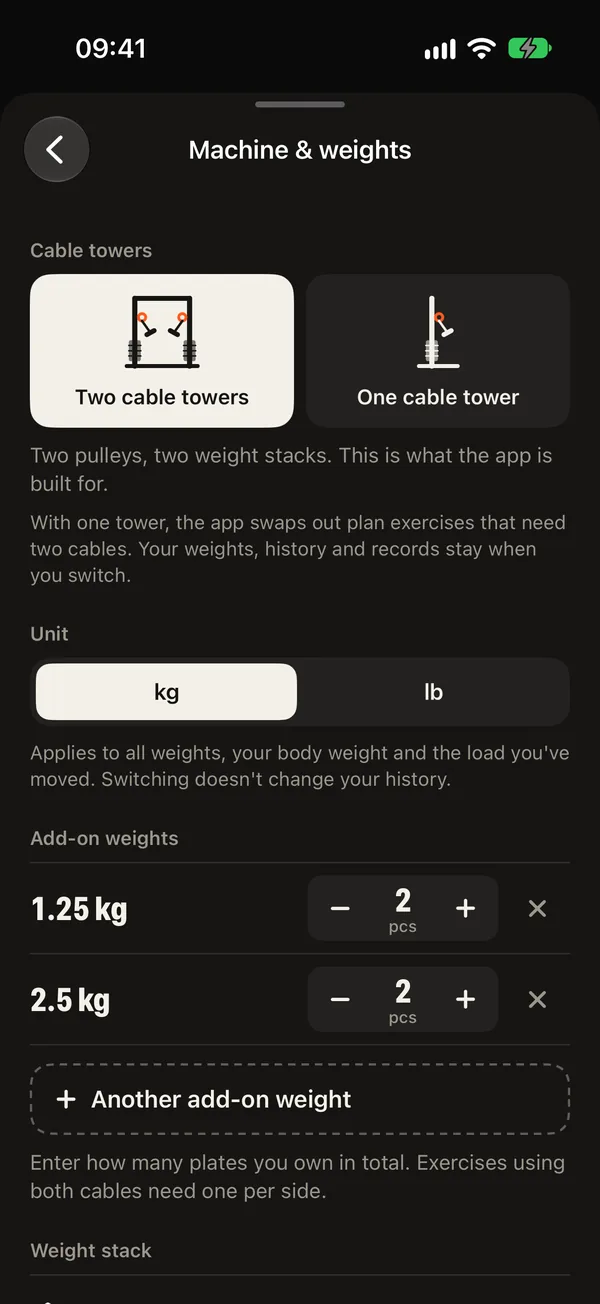
Plate 18+ 2.5 kg
In DCFT
The app plans with your discs
In DCFT you enter your add-on weights once, as an inventory. The app then builds the steps between your plates and tells you in every set what to set.
- Each weight with how many pieces you own in total, up to four sizes, in kg or lb
- Works for two cable towers or one
- Exercises with both cables use one disc per side
- You set how many discs fit on your pin at once, up to three
- The plate hint shows the sum, for example “Plate 18 + 2.5 kg”
- Discs as heavy as a plate or heavier: the app asks once when you add them and only uses them once the full stack is not enough
More about the setup: features
How the app raises the weight step by step: how your plan adapts
Safety in short
Treat added weight like part of the stack: pin all the way in, discs flat, lift and lower under control, fingers away from the plates. If anything scrapes, tilts or jams, stop, lower the stack and take the discs off. Stay within the maximum load of your machine and follow the rules of your gym.
Questions about added weight
Can you add weight to a cable machine?
Yes. Small discs between the top plate and the head plate (the pin-through trick), on a long pin or flat on top of the stack all move with the stack. Check the maximum load of the machine and the rules of your gym.
Does weight on top of the stack count?
Yes. The head plate is fixed to the selector rod and lifts on every rep, so a weight lying on it always moves along. It just has to lie flat and stay put.
How much heavier does a 2.5 kg disc make it?
At a 1:1 pulley ratio you feel 2.5 kg more at the handle, at 2:1 about 1.25 kg, plus a little friction.
Is the pin-through trick safe?
With discs that fit over the rod, lie flat and a pin pushed in all the way, the rod keeps the discs centred and they cannot slide off. Lift and lower under control and never reach between the plates.
What can I do when the full stack is too light?
Add discs with the pin-through trick, slow down the tempo, add reps or pauses, or switch to a one-arm version of the exercise. DCFT only uses heavy add-on weights once the full stack is not enough.
Do magnetic add-on weights work?
Yes, for small steps. They stick to the top plate or the side of the stack. Stay within the stated load and lower the stack gently so they do not come loose.
Train with a plan that knows your discs

On the App Store for iPhone. Start with 14 days of DCFT Pro free.
More: pulley ratio guide · FAQ · all exercises · all guides