
Guide
More weight or more reps? What the research says
Heavy for strength, light to tone, 8 to 12 for size: the gym has a rule for everything. Here is what controlled studies actually found, in plain words, with every source linked at the end.
In short
- Muscle size: heavy, moderate and light loads built similar muscle when sets went to or close to failure [1,2]. Only very light loads fell behind [3,4].
- Max strength: heavier loads win [1,2,5]. If a bigger one-rep max is your goal, lift heavy at least some of the time.
- Effort: how close you get to failure matters, especially with light loads [6,7]. Actual failure is optional [8].
- Progression: adding reps worked about as well as adding weight in a direct comparison [9].
- On a cable stack: climb through your rep range at one weight, then go one plate up. That is double progression, and it is how DCFT plans your sets.
Five terms first
- Load
- The weight you lift. Studies often give it as a percentage of your one-rep max.
- 1RM
- One-rep max: the most you can lift once with good form. 30% of 1RM is a light load, 80% a heavy one.
- Failure
- The point where you cannot finish another rep with good form.
- RIR
- Reps in reserve: how many more clean reps you could have done when you stopped. 0 RIR is failure.
- Volume
- Here: how many hard sets you do for a muscle per week.
Muscle growth
For muscle, a wide range of loads works
The classic rule calls 8 to 12 reps the “hypertrophy zone”. Controlled studies do not support one single zone.
A 2017 meta-analysis of 21 studies, with all sets taken to failure, found similar muscle growth with low loads (60% of 1RM or less) and high loads [1]. A 2021 network meta-analysis of 28 studies with 747 adults found no difference in growth between heavy (8 reps or fewer), moderate (9 to 15) and light loads (more than 15) [2].
In trained men, 8 weeks of sets with 25 to 35 reps built about as much muscle as sets of 8 to 12 [10]. The 2026 position stand of the American College of Sports Medicine, which pooled 137 systematic reviews, found that load did not change muscle growth, while weekly volume did [5].
Where it stops working
- Very light loads. In a 12 week study with untrained men, training at 20% of 1RM gave roughly half the growth of 80%, with the work matched [3]. A review puts the lower limit for similar growth at about 30% of 1RM [4].
- Light loads without effort. At 30% of 1RM, leg extension sets to failure (about 34 reps) grew the thigh muscles about as much as heavy sets. The same load stopped well short of failure gave no significant growth [6].
- Very heavy sets with few reps. When trained men did the same number of sets with 2 to 4 or 8 to 12 reps, the thigh grew more with 8 to 12. The arm muscles showed no significant difference [11]. The reviewers’ reading: heavy loads can build as much muscle, but need more sets to get there [4].
Sets count as well. More weekly sets bring more growth, with diminishing returns [12,13]. The ACSM names 10 or more sets a week for growth [5].
Effort
How close to failure: the part that matters
If load matters this little for growth, what does? Effort. Muscle growth improved as sets ended closer to failure in a series of meta-regressions, while strength gains were similar across a wide range. The authors call their analysis exploratory [7].
Going all the way is not required. A meta-analysis of 15 studies found no clear advantage of training to failure over stopping short [8]. In trained lifters, stopping 1 to 2 reps short built as much thigh muscle in 8 weeks as going to failure [14].
Failure has a cost. On the bench press, sets to failure caused far more fatigue right after training than stopping 1 or 3 reps short, and discomfort rose the closer people got to failure [15].
Can you judge your reps in reserve? Trained lifters guessed when they had 1 or 3 reps left on the bench press with an average error of less than one rep [16].
Strength and endurance
Heavier is better
Max strength
For a bigger one-rep max, heavy loads beat light ones [1,2]. In the network meta-analysis, heavy and moderate loads both beat light loads; heavy was ahead of moderate, but not significantly [2]. The ACSM names loads of 80% of 1RM or more [5]. Part of this is practice: 1RM tests use heavy single reps. On isometric strength tests, the difference between loads was not significant [1].
Less clear than you think
Local endurance
Light, high-rep sets are supposed to build endurance. In one study, reps at 50% of 1RM on the bench press rose by 16.6% after light training and barely changed after 8 to 12 rep training [10]. Across all studies the picture is mixed: the review calls a load-specific effect on endurance equivocal [4].
The catch
The catch with very light and very heavy
If similar growth is possible across the range, why do most programs sit in the middle? Practical reasons:
- Light sets hurt more. Light loads taken to failure cause more discomfort and feel harder than moderate or heavy loads [4]. In the progression study, the group adding reps had more trouble getting close to failure, likely because of the burn [9].
- Many reps take time. A set of 30 reps lasts much longer than a set of 10. The review authors see moderate loads as the most time-efficient way to build muscle [4].
- Very heavy sets need more sets. In the reviewers’ view, heavy loads combined with high volume also add joint stress [4].
- Light sets only work with real effort. Far from failure, a light load did little [6].
Progression
Add weight or add reps?
Progressive overload means asking a little more of your muscles over time. Most people think of adding weight. Adding reps can do the same job.
A 2022 study tested exactly this. 43 people with at least a year of lower body training trained for 8 weeks, starting at 8 to 12 reps. One group added weight and stayed in that range, the other kept the weight and added reps. Muscle growth, strength and endurance came out about the same. The small differences (a bit more growth in one thigh muscle with reps, a bit more strength with weight) were of questionable practical significance [9].
Keep the limits in mind: 8 weeks, thighs and calves only, trained people [9].
Double progression: both, in turn
Most programs combine the two. You stay at one weight and add reps until you reach the top of your range, then add weight and start again near the bottom. This is called double progression.
It has not been tested head to head against the two pure methods, but it uses both levers that worked in the study above. The older ACSM guideline from 2009 described the same idea: raise the load by 2 to 10% once you can do one or two reps more than your target [17].
On a cable stack
Why reps do the heavy lifting on a stack
This part is practical reasoning, not a study result. A weight stack moves in fixed steps, often 5 kg or 10 lb. On a small exercise like a lateral raise, going from 15 to 20 kg is a third more weight in one go.
You will lose a few reps when you move up, so you need room to fall back into. A rep range gives you that room: work up to the top, then the drop to the bottom of the range after the next plate is planned, not a setback.
Steps still too big? Small add-on discs split them. Three ways to add weight to a cable machine.
+1 stepafter the top of the range
In DCFT
How DCFT handles it
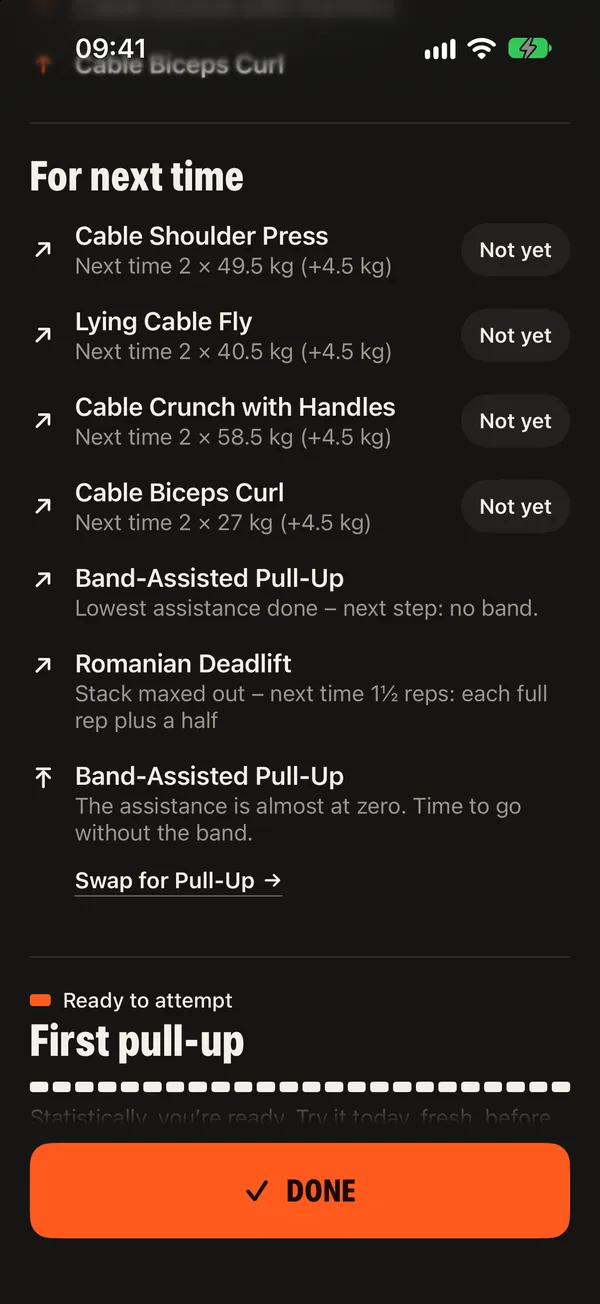
DCFT uses double progression. Every exercise has a rep range, and the app suggests the next step in every set.
- Every exercise has a rep range, for example 8 to 12 reps
- Same weight as last time: DCFT suggests one more rep, up to the top of your range
- Top of the range in all work sets: “Every rep clean?” Then one step heavier next time. “Not yet” keeps the weight
- One step is the next plate, or a smaller one with your add-on weights
- A set far too light: DCFT offers more weight for the very next set
- Below the range twice: one step lighter, so your reps stay clean
More on this: how your plan adapts
Questions about weight and reps
Is it better to lift heavier or do more reps?
For muscle growth, both work: studies found similar growth across a wide range of loads when sets went to or close to failure. For maximum strength, heavier loads work better. Many people do well with a moderate rep range and progress by adding reps first, then weight.
How many reps should I do to build muscle?
There is no single best number. Studies found similar growth with heavy sets of 8 reps or fewer, moderate sets of 9 to 15 and light sets of more than 15, as long as sets went to or close to failure. Very light loads (20% of the max in one study) fell behind, and very heavy sets of 2 to 4 reps seem to need more sets for the same growth.
Do light weights with high reps tone muscles?
There is no separate toning effect in the studies. Light loads build muscle size like heavier loads, as long as the sets end close to failure. Light sets stopped far from failure did much less.
Do I have to train to failure?
No. A meta-analysis found no clear advantage of failure over stopping short, and stopping 1 to 2 reps short built as much muscle in trained lifters. Failure adds fatigue. With light loads, getting close to failure matters more.
Should I add weight or reps first?
Both work. In a direct comparison, adding reps at the same weight and adding weight within a rep range gave similar results over 8 weeks. Double progression combines them: reps first, then weight.
Why does DCFT suggest one more rep instead of more weight?
Because a stack moves in big steps. One more rep at the same weight keeps you progressing. Once you reach the top of your rep range in all work sets, DCFT moves you one step heavier.
Sources
All studies were checked on 26 October 2026. Links go to the DOI or PubMed entry.
- Schoenfeld BJ, Grgic J, Ogborn D, Krieger JW (2017). Strength and hypertrophy adaptations between low- vs. high-load resistance training: a systematic review and meta-analysis. J Strength Cond Res. 2017;31(12):3508-3523. doi.org/10.1519/JSC.0000000000002200Meta-analysis of 21 studies, all sets to failure, low load 60% of 1RM or less.
- Lopez P, Radaelli R, Taaffe DR, et al. (2021). Resistance training load effects on muscle hypertrophy and strength gain: systematic review and network meta-analysis. Med Sci Sports Exerc. 2021;53(6):1206-1216. doi.org/10.1249/MSS.0000000000002585Network meta-analysis of 28 studies, 747 healthy adults, sets to failure.
- Lasevicius T, Ugrinowitsch C, Schoenfeld BJ, et al. (2018). Effects of different intensities of resistance training with equated volume load on muscle strength and hypertrophy. Eur J Sport Sci. 2018;18(6):772-780. doi.org/10.1080/17461391.2018.145089830 untrained men, 12 weeks, 20% vs 40, 60 or 80% of 1RM.
- Schoenfeld BJ, Grgic J, Van Every DW, Plotkin DL (2021). Loading recommendations for muscle strength, hypertrophy, and local endurance: a re-examination of the repetition continuum. Sports (Basel). 2021;9(2):32. doi.org/10.3390/sports9020032Narrative review. Full text read.
- Currier BS, D’Souza AC, Singh MAF, et al. (2026). American College of Sports Medicine Position Stand. Resistance training prescription for muscle function, hypertrophy, and physical performance in healthy adults: an overview of reviews. Med Sci Sports Exerc. 2026;58(4):851-872. doi.org/10.1249/MSS.0000000000003897Overview of 137 systematic reviews. Replaces the 2009 position stand. Full text read.
- Lasevicius T, Schoenfeld BJ, Silva-Batista C, et al. (2022). Muscle failure promotes greater muscle hypertrophy in low-load but not in high-load resistance training. J Strength Cond Res. 2022;36(2):346-351. doi.org/10.1519/JSC.000000000000345425 untrained men, 8 weeks, leg extension at 30% or 80% of 1RM, to failure or not.
- Robinson ZP, Pelland JC, Remmert JF, et al. (2024). Exploring the dose-response relationship between estimated resistance training proximity to failure, strength gain, and muscle hypertrophy: a series of meta-regressions. Sports Med. 2024;54(9):2209-2231. doi.org/10.1007/s40279-024-02069-2Exploratory meta-regressions, reps in reserve estimated from the study descriptions.
- Refalo MC, Helms ER, Trexler ET, Hamilton DL, Fyfe JJ (2023). Influence of resistance training proximity-to-failure on skeletal muscle hypertrophy: a systematic review with meta-analysis. Sports Med. 2023;53(3):649-665. doi.org/10.1007/s40279-022-01784-yMeta-analysis, 15 studies.
- Plotkin D, Coleman M, Van Every D, et al. (2022). Progressive overload without progressing load? The effects of load or repetition progression on muscular adaptations. PeerJ. 2022;10:e14142. doi.org/10.7717/peerj.1414243 trained adults, 8 weeks, lower body. Full text read.
- Schoenfeld BJ, Peterson MD, Ogborn D, Contreras B, Sonmez GT (2015). Effects of low- vs. high-load resistance training on muscle strength and hypertrophy in well-trained men. J Strength Cond Res. 2015;29(10):2954-2963. doi.org/10.1519/JSC.000000000000095818 trained men, 8 weeks, 25 to 35 vs 8 to 12 reps per set, to failure.
- Schoenfeld BJ, Contreras B, Vigotsky AD, Peterson M (2016). Differential effects of heavy versus moderate loads on measures of strength and hypertrophy in resistance-trained men. J Sports Sci Med. 2016;15(4):715-722. pubmed.ncbi.nlm.nih.gov/27928218/19 trained men, 8 weeks, 2 to 4 vs 8 to 12 reps, same number of sets.
- Schoenfeld BJ, Ogborn D, Krieger JW (2017). Dose-response relationship between weekly resistance training volume and increases in muscle mass: a systematic review and meta-analysis. J Sports Sci. 2017;35(11):1073-1082. doi.org/10.1080/02640414.2016.1210197Meta-regression, 15 studies.
- Pelland JC, Remmert JF, Robinson ZP, Hinson SR, Zourdos MC (2026). The resistance training dose response: meta-regressions exploring the effects of weekly volume and frequency on muscle hypertrophy and strength gains. Sports Med. 2026;56(2):481-505. doi.org/10.1007/s40279-025-02344-wMeta-regressions, 67 studies, 2058 participants.
- Refalo MC, Helms ER, Robinson ZP, Hamilton DL, Fyfe JJ (2024). Similar muscle hypertrophy following eight weeks of resistance training to momentary muscular failure or with repetitions-in-reserve in resistance-trained individuals. J Sports Sci. 2024;42(1):85-101. doi.org/10.1080/02640414.2024.232102118 trained adults, 8 weeks, leg press and leg extension, failure vs 1 to 2 reps in reserve.
- Refalo MC, Helms ER, Hamilton DL, Fyfe JJ (2023). Influence of resistance training proximity-to-failure, determined by repetitions-in-reserve, on neuromuscular fatigue in resistance-trained males and females. Sports Med Open. 2023;9(1):10. doi.org/10.1186/s40798-023-00554-y24 trained adults, bench press at 75% of 1RM, failure vs 1 or 3 reps in reserve.
- Refalo MC, Remmert JF, Pelland JC, et al. (2024). Accuracy of intraset repetitions-in-reserve predictions during the bench press exercise in resistance-trained male and female subjects. J Strength Cond Res. 2024;38(3):e78-e85. doi.org/10.1519/JSC.000000000000465324 trained adults, bench press at 75% of 1RM.
- American College of Sports Medicine (2009). American College of Sports Medicine position stand. Progression models in resistance training for healthy adults. Med Sci Sports Exerc. 2009;41(3):687-708. doi.org/10.1249/MSS.0b013e3181915670Older guideline, replaced by the 2026 position stand above. Cited here for its progression rule.
This guide is general information about training research, not medical advice. If you have an injury, a health condition or pain while training, talk to a doctor or physiotherapist first.
Train with a plan that adds reps, then weight

On the App Store for iPhone. Start with 14 days of DCFT Pro free.
More: all guides · FAQ · all exercises