
Guide
How much weight is on a cable machine, really?
You pin 40 kg and it feels like 20. Or it feels heavier than the dumbbell with the same number. Here is what the number on the stack means, what changes it on the way to your hands, and how to compare.
- Handle travel
- Stack travel
÷ ratiostack to handle
In short
- The number on the plates is the mass of the plates you pin. It is accurate for the stack.
- At the handle you get roughly stack weight ÷ pulley ratio: the full stack at 1:1, about half at 2:1.
- Friction makes the lift a little heavier and the lowering a little lighter than that.
- A cable pulls along the cable, not straight down, so the hardest part of a move is somewhere else than with a dumbbell.
- The head plate and selector rod move on every rep too, and the label may or may not count them.
- There is no exact conversion to dumbbells. Compare the force at the handle, then go by reps.
What the number on the stack means
Each plate is labelled with its mass, in kilograms or pounds. Pin plate 8 on a stack of 5 kg plates and you lift 40 kg of plates. Gravity pulls on those 40 kg exactly as it pulls on a 40 kg dumbbell.
So the number is honest about the stack. What reaches your hands is another question. Between the stack and the handle sit pulleys, a cable, some friction and the direction you pull in, and each of them changes what you feel.
One more detail: the pin picks up more than the plates. The head plate on top of the stack and the selector rod hanging from it rise on every rep. On some 2:1 machines a pulley is mounted on top of the stack and rides along as well. Some machines count these parts in the first plate, others do not. The manual is the place to check.
Strictly speaking, kilograms measure mass and what you feel is a force. In the gym both are called weight, and this guide does the same: “20 kg at the handle” means the pull of a 20 kg dumbbell held still.
- 1:1: full force, short pull
- 2:1: half the force, twice the distance
Pulley ratio: why 2:1 feels like half
On a 1:1 machine the cable runs from the handle over fixed pulleys straight to the stack. A fixed pulley only changes the direction of the pull, not its size. The handle and the stack travel the same distance and you pull about the full stack weight.
In a typical 2:1 setup the stack hangs from a pulley that moves with it, held by two lengths of cable. Each length carries half the load, so the handle needs about half the force. The price: the handle travels twice as far as the stack.
The work is the same either way. Half the force over twice the distance lifts the same plates the same height. A 2:1 machine does not make the stack lighter. It spreads the same work over a longer pull, which is what makes long movements like a cable fly possible.
Other ratios exist, such as 3:1 or 4:1. The rule stays the same: divide the stack weight by the first number. Not sure which ratio your machine has? The pulley ratio guide shows how to find out and has a calculator.
Friction: heavier up, lighter down
Real pulleys and cables are not frictionless. The bearings, the cable bending around each pulley and the plates sliding on their guide rods all take a little force. Part of your effort turns into heat instead of lifting.
Friction always works against the motion. While the stack rises, you pull its weight plus the friction. While it comes back down, friction helps you hold it, so you need less force than the weight.
That is why the lowering phase on a cable machine is a little lighter than the lift, while a dumbbell weighs the same both ways. More pulleys in the cable path, worn bearings or dry guide rods usually mean more friction.
How big is the difference? It depends on the machine and its condition. We have not found reliable measurements for cable machines, so we do not put a number on it.
Why the first centimetres feel heaviest
Two things add up at the start of a rep. Static friction is usually larger than sliding friction, so the stack takes a little more force to get going than to keep moving. And speeding up any mass takes extra force on top of its weight. Once the stack moves steadily, both ease off. Start each rep smoothly instead of yanking.
- Without friction
- Friction, against the motion
- Not to scale
- Line of pull
- Lever from the shoulder
- Same weight in both
Line of pull: where the exercise gets hard
A dumbbell is always pulled straight down by gravity. A cable pulls along the cable, towards the pulley. The force at the handle stays about the same, but its direction changes as you move.
What your muscles feel is the force times its lever: how far the line of pull passes from the joint. With a dumbbell, in a raise or a curl, that lever is longest when the moving arm is horizontal. With a cable it is longest when the cable meets your arm at a right angle.
Take the lateral raise. With a dumbbell it is easy at the bottom and hardest at the top. With a cable from a low pulley across the body it is already hard at the bottom, where the shoulder muscle is stretched. A 2025 study compared both over eight weeks and found similar growth of the side delts, so neither is wrong. They just load the move differently.
This is why a cable exercise can feel heavier or lighter than its free weight version at the same number. Move the pulley or your stance and the hardest point moves with it.
Why the same number feels different on another machine
If 30 kg feels easy at home and hard in the gym, one of these is usually the reason.
Pulley ratio
1:1, 2:1 and others. The same pin gives a full, half or smaller force at the handle.
Friction
More pulleys, older bearings or dry guide rods add drag. You feel it most on the lift.
Head plate
Counted in the first plate on one machine, not counted on another.
Labels
Plates marked in pounds or kilograms. A 10 lb plate is about 4.5 kg, not 5.
Pulley height and stance
They change the line of pull and with it the hardest point of the move.
Shared stacks
If two handles hang from one stack, they share its load. On a dual cable machine each side has its own.
Stack jumps: smaller at the handle than on the label
The ratio also changes the step size. With 5 kg plates, one plate more adds 5 kg at the handle on a 1:1 machine but only about 2.5 kg on a 2:1 machine.
Even that can be a big jump on a lateral raise or a triceps pushdown. Small add-on discs give you steps in between. Three ways to add weight to a cable machine, and how the ratio affects them.
- 1:1
- 2:1
Cable weight vs dumbbell weight
There is no exact conversion. Ratio, friction, the head plate and the line of pull differ from machine to machine and from exercise to exercise. Any fixed formula would be wrong for most of them.
What works instead:
- Find the force at the handle. Divide the stack weight by the ratio: 30 kg at 2:1 is about 15 kg.
- Compare per hand. On a dual cable machine each handle has its own stack, just as each hand holds its own dumbbell.
- Expect a different hard point. The cable version may be harder at the bottom and easier at the top, or the other way round.
- Let your reps decide. Pick a weight you can lift for your target reps with good form and one or two in reserve, then adjust next time.
2:1set once at setup
In DCFT
DCFT knows your stack
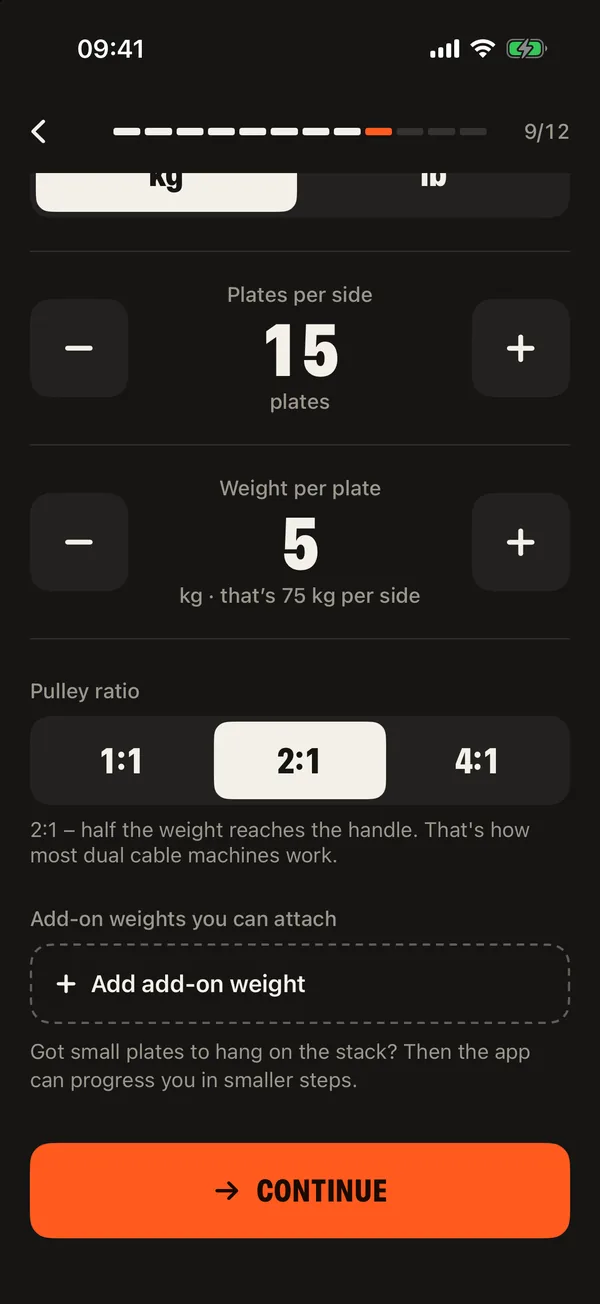
At setup DCFT asks how your machine is built, so your plan matches the plates in front of you.
- You enter the plate unit, plates per side, the weight per plate and the pulley ratio, 1:1, 2:1 or 4:1.
- Your plan shows weights the way you pin them, with the plate number, so you never convert in your head.
- For records, volume and your strength level DCFT uses the load at the handle: the pinned weight divided by the ratio, both sides added up when you use two cables.
- Friction, the head plate and the line of pull are not in that number. The fitness check measures what you lift on your own machine, and your weights adjust after every workout to what you actually lifted.
More about what DCFT does and questions about your machine.
Questions about cable machine weight
Is 2:1 half the weight?
At the handle, yes, roughly: you need about half the stack weight in force, before friction. The stack itself weighs the same, and you pull the handle twice as far as the stack rises. 40 kg on a 2:1 machine feels about like 20 kg on a 1:1 machine.
Do cable machines show the real weight?
The plates show their real mass, so the number is right for the stack. It is not the force at the handle. Pulley ratio, friction, the head plate and the cable angle all sit in between, so the handle force is only roughly the stack weight divided by the ratio.
Why does the cable feel heavier at the start of a rep?
Getting the stack moving takes more force than keeping it moving. Static friction is usually larger than sliding friction, and speeding up the stack takes extra force on top of its weight. Once it moves steadily it feels lighter. Start smoothly instead of jerking the handle.
Why does lowering feel lighter than lifting on a cable machine?
Friction in the pulleys and on the guide rods always works against the motion. On the way up you pull the weight plus friction, on the way down friction helps you hold it. A dumbbell has no pulleys, so it weighs the same both ways.
How do cable weights compare to dumbbells?
There is no exact conversion. Start with the force at the handle (stack weight divided by the ratio), compare it per hand, and expect the hardest point of the move to differ. Then pick the weight by your reps, not by the number.
Why does the same weight feel different on another cable machine?
Usually because of a different pulley ratio. Friction, whether the head plate is counted, plates labelled in pounds instead of kilograms and the pulley height also play a part.
Sources
- OpenStax College Physics 2e, 9.5 Simple Machines: pulleys, mechanical advantage and the trade of force against distance.
- OpenStax College Physics 2e, 5.1 Friction: friction opposes motion, static friction is usually larger than kinetic friction.
- OpenStax College Physics 2e, 7.6 Conservation of Energy: efficiency, useful work is less than the energy put in.
- OpenStax College Physics 2e, 4.3 Newton’s Second Law: accelerating a mass takes force.
- Larsen S. et al. (2025). Dumbbell versus cable lateral raises for lateral deltoid hypertrophy: an experimental study. Frontiers in Physiology 16:1611468.
Train with weights that fit your machine

On the App Store for iPhone. Start with 14 days of DCFT Pro free.
More guides: pulley ratio and calculator · add weight to a cable machine · all exercises